Aren’t Japanese games
already covered to death?
It’s true that the significant niche of Japanese games does
get a fair share of press coverage: dedicated sites such as
Gematsu and
Siliconera
collate information from press releases, whisperings from Japanese publications
such as Famitsu and Dengeki and reputable leak sources as well as keeping us up
to date on sales figures through Media Create. These sites exist and thrive
precisely because there’s a group of information-thirsty readers out there
whose fervour for Japanese games hasn’t diminished even if the clout and
significance of the Japanese videogame market as a whole has for the great
majority of the western gaming press.
Imported Goodness isn’t my attempt to steal their Thunder™
(truth be told I wouldn’t know what to do with it), but rather plug a niche gap
that’s always bothered me: although sites such as Gematsu are excellent at
keeping us in the know about Japanese imports months before western release, they
don’t offer uncompromising, detailed and (above all) critical coverage of them the way the western press does for
localised releases. In fact, no one does. If you want to read a high
quality, no-nonsense review on an import there’s nowhere to turn.
Why doesn’t the
western videogame press cover imports?
The reasons for this are a combination of business and practicality:
reviewing the Japanese version of a game months before western release might
disqualify a publication from localised review code, or at least make it harder
to justify reviewing the same game twice. And, more likely, many of these
publications simply don’t have Japanese-English bilingual staff who can make any
kind of sense out of the text-heavy contexts the games they’re playing are
rooted in. Without context their observations become, at best, superficial
deductions that site visitors (in the post-Youtube-era) can make for
themselves.
 |
| Monolingual journalist observation: Oooh pretty!! |
So the best place to
turn is consumer reviews?
Readers are left in the unenviable position of getting their
critical commentary on imports from exuberant super-fans (the exact opposite of
critical) whose grasp of Japanese might be suspect at best (or a source of
ill-earned holier-than-thou egotism at worst), or relying on translations of
questionable accuracy of Famitsu’s one paragraph reviews — which themselves are
of questionable integrity. That, or the reader has to rely on the succession of
Japanese-whispers as rumour and fact coalesce and swap places across time and repeated
misreporting.
So is it all
hopeless?
Japanese-English bilinguals who are well-read in videogames
are common enough, as are sharp-penned writers, but rarely the two meet: and
that’s where I come in. I’m a Japanese-English bilingual who’s been honing his
writing skills for the last 18 months under the tutelage of several editors.
First at
Continue Play (which has grown
immensely over the last year or so) and then at
Automaton, a curious site that
operates under the auspices of
Active
Gaming Media (a localisation outfit-meets-publisher, responsible most recently
for the PC release of
D4) that runs
in both English and Japanese.
But surely there are
some reliable Japanese videogame critics?
Well… not really. In fact my go-to outlet for Japanese videogame
criticism is Amazon’s Japanese customer
reviews (which are, thankfully, softer spoken and better punctuated than their “barbaric”
English counterparts). So rare are actual Japanese videogame “critics” that the
Japanese side of Automaton has seen explosive growth owing to the fact that it has
critical (even anti-publisher) criticism as part of its repertoire of article
types.
 |
| Sadly "currently" the most reliable place for Japanese videogame criticism |
That’s nothing new for those accustomed to the western
gaming press, but it’s a refreshing change of pace in Japan, where most
videogame coverage is dictated top-down from the publisher, making Japanese
videogame press little more than PR-mouthpieces. But this goes back to my
original point: looking to (translations of) the Japanese press for critical
coverage of Japanese games isn’t going to work when the number of critical publications can be counted by
the innumerate.
So you’re planning on
only covering imports?
The original concept behind Imported Goodness all those months ago (before I was swept off to
write for other people’s sites) was to show off my collection of import games,
whilst offering up interesting facts and insights into the games covered. But the reborn Imported Goodness is
going to expand to take into account some major changes since this blog was
first started:
1)
Traditional
Critical Coverage (Reviews, Previews, Interviews)
Since starting this blog I’ve spent a
significant amount of time reviewing games from discs sent out by publishers
and review codes, as well as covering pre-release builds of games either sent
to me by the publisher or played at press events. It would be crazy not to leverage whatever press
access/credentials I have.
2)
Localised
Games
With press credentials comes advanced
access to localised versions of Japanese games. Naturally I’ll be covering
these as well.
3)
PC
Games
There’s been a notable shift over the last
couple of years (even the last couple of months) where Japanese developers, who
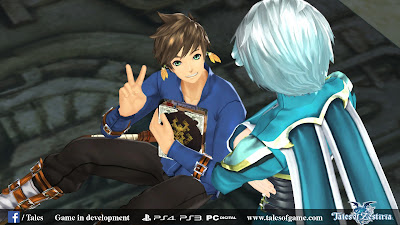
are increasingly internationalising, have started taking the PC more seriously. Most recently Square Enix announced Final
Fantasy Type-Zero HD only mere months after the home console release, and
Bandai Namco announced a
PC version of Tales of Zestiria
(and a potential Tales of Symphonia
port) in advance of the game’s western console release.
 |
| Celebrations on the Tales of Zestria port started somewhat early |
There’s been a marked acceleration in Japanese PC announcements and the gap
between console and PC releases has shrunk as well, meaning the PC is
increasingly a viable place to play Japanese games.
Sadly many PC-centric outlets are staffed
by writers weaned nearly exclusively on western games, and many writers who
grew up on Japanese games wouldn’t know their SATA ports from a PCI-e socket. Imported
Goodness then, will attempt to bridge the “Japanese games on PC niche” both by
writing on Japanese PC games that should appeal to the traditional
console-based gamer, and by reporting on PC games that may fall slightly
outside of the readership’s gaming diet (but might overlap with their tastes
all the same).
That, and it allows me to work a loophole
into this blog so I don’t end up having to play Japanese games and nothing but
for the rest of my life.
Of course this is only the beginning for Imported Goodness.
I hope to expand the blog to include regular features (with many experiments in
the works) in addition to news, reviews, previews, interviews and everything else on my checklist.
So is this blog aimed at Japanophiles?
I want to hit two audiences with this blog. Firstly the audience that doesn't understand Japanese and wants to look at imports from the outside in. They'll be the culturally and linguistically uninitiated that I'll escort through a kind of virtual tourism as seen through videogames.
Secondly (and more selfishly) I want to use this blog as a dialogue between like-minded Japanese-able importers to share and exchange their opinions and experiences with Japanese games. These people often find that, even if they live in Japan, they are only able to talk about games with their colleagues and acquaintances in the most superficial terms. When you look back at the kind of "criticism" (or lack thereof) that many Japanese gamers are accustomed to perhaps this isn't surprising.
For this latter audience I'll be looking into topics such as which western game releases feature Japanese text/audio and how to activate the source Japanese content.


